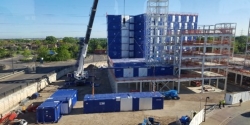

CHICAGO, Illinois, August 18, 2026 — Bally’s Chicago halted most construction on non-gaming components of the $1.7 billion casino complex. On August 8, the company sent a reset notice to Chicago Community Builders Collective, its general contractor. Active construction is taking place only on the casino floor itself.
A Dispute Over Video Gambling
Chicago only legalized video gambling terminals citywide earlier this year in January 2026. Bally’s says the expansion violates a commitment Bally’s made in its Host Community Agreement not to expand gaming citywide. In its own notice, the company noted, “The potential for an uncontrolled proliferation of video gambling terminals is in breach of the City’s commitment not to expand gaming in the Host Community Agreement and creates uncertainty that could be harmful for Bally’s Chicago prospects”.
Between January and July, video gambling terminals generated roughly $532 million in state revenue, compared with $222 million from casinos. Industry analysts were informed that Bally’s estimated terminals could dilute its revenue earnings by more than $74 million a year. Company representatives stated that if Bally’s had known due to a changing business environment that video terminals were going to grow so large, it would have acted differently during its initial negotiations with the city.
Thousands of Workers Idled
The hotel, restaurants and events center are just the latest victims of the halt that has left up to 1,500 union tradespeople facing potential displacement. That includes a 34-story hotel tower envisioned for the River West neighborhood. Despite the broader slowdown, Bally’s says the casino itself remains on schedule to debut in early 2027.
Members of the Chicago City Council have raised concerns and called for Bally’s to immediately resume full construction. “Most of us are guessing that this is, in fact, a cash-flow issue, and we dispute the rationale provided by the company,” Ald. Brendan Reilly said. Bally’s and the Johnson administration, meanwhile, have also been put on notice by council members who called for a public hearing into potential changes to financing terms.
A Pattern of Setbacks
It is the latest major halt in construction since Bally’s won Chicago’s casino license to build a venue on the site near the Loop in 2022. Delays earlier in the project have included historical site clearance issues, regulatory stop-work orders, and discrepancies with city water lines. It has also faced an $800 million funding gap on the project that required financial restructuring and alterations to its original hotel proposals.
Last week Bally’s issued a going-concern warning to investors due to wider liquidity pressure. The company says the warning doesn’t stem directly from the Chicago construction slowdown but rather unrelated corporate developments. How investors view that distinction may affect how city officials handle the standoff.
During the same seven-month period, Illinois’ 17 casinos generated just over $430 million in tax revenue. It is that gap that helps to explain why Bally’s sees the terminal expansion as a competitive threat directly confronting its business model. Meanwhile, city officials view the terminals as a quick source of new revenue for 2026.
What Comes Next
Bally’s enlisted law firm RKF Global to consider possible litigation against the city. As an additional source of revenue, stakeholders have also discussed proposals regarding installing slot machines at O’Hare and Midway airports. Both the mayor’s office and the contracting collective didn’t immediately respond to requests for comment.
City Council members anticipate the battle will heat up as a date for the requested public hearing draws near. The casino’s timeline has slipped repeatedly since Bally’s won the Chicago license in 2022. There have been continued movements on the casino floor, even with adjacent buildings sitting empty.
That split image — one crane active in mid-air and one still on the ground — summarizes where the project is now. Other Chicago megaprojects have moved ahead despite the fight over the casino, including a $5.7 billion Red Line transit expansion. Nearby, a new $750 million stadium for the Chicago Fire soccer club remains on schedule.
That dichotomy has bred skepticism among aldermen who have questioned Bally’s explanation of what caused the slowdown. For now, the battle remains over money, blame and who ultimately controls the tempo of the project. Once set, the next public hearing should provide by far the best indication on where this dispute is heading.