By Andrew Calloway
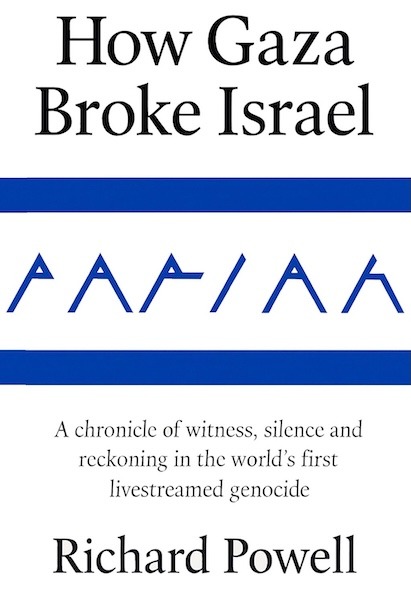
For decades, the Israel–Palestine conflict has functioned as a moral reference point in global politics. Richard Powell’s Pariah: How Gaza Broke Israel argues that the Gaza war transformed that reference point into a diplomatic catalyst. In his reading, the conflict accelerated a shift in how states outside the Western alliance system evaluate Israel, international law and American influence.
Powell does not frame Gaza as a sudden rupture in global alignment. Instead, he presents it as an accelerant. The underlying scepticism toward Western claims of universal standards was already visible across parts of Africa, Latin America and Asia. Gaza intensified that scepticism under conditions of extreme visibility.
The book opens with structural analysis. Powell revisits the blockade, border controls and demographic strategies that shaped Gaza long before October 2023. By grounding the conflict in long-term containment logic, he situates the humanitarian devastation within a broader policy continuum.
From there, the analysis widens geographically. Powell examines voting patterns at the United Nations General Assembly and Security Council debates. Several governments in the Global South, he notes, framed the conflict through the language of accountability and proportionality rather than security necessity. The contrast with Western diplomatic caution became pronounced.
Brazil, South Africa and Indonesia feature in Powell’s discussion as examples of governments invoking international humanitarian law with increasing clarity. While each country’s domestic politics differ, Powell suggests that Gaza served as a moment of convergence around the principle of civilian protection.
The legal dimension reinforces this divergence. Proceedings at the International Court of Justice, particularly provisional measures and genocide-related filings, were closely watched across the Global South. Powell argues that these developments legitimised diplomatic criticism that might previously have been dismissed as rhetorical.
China and Russia also enter the analysis, though Powell avoids simplistic bloc framing. Instead, he suggests that Gaza provided geopolitical competitors of the United States with an opportunity to position themselves rhetorically as defenders of international law.
The book does not ignore strategic calculation. Powell acknowledges that economic relationships, defence contracts and energy interests shape diplomatic positioning. Eastern Mediterranean gas reserves and regional trade corridors complicate any purely moral reading of alignment.
Yet Powell insists that public opinion matters. Mass protests in Western capitals and sustained demonstrations across Latin America and Southeast Asia signalled that Gaza resonated beyond diplomatic chambers. Generational political consciousness, he argues, is shifting.
The United States remains central to this geopolitical recalibration. Powell reviews congressional funding decisions and vetoes at the United Nations. While formal support for Israel remained consistent, the reputational cost within parts of the Global South deepened perceptions of selective enforcement.
The prose throughout is assertive but measured. Powell does not reduce international relations to binary camps. Instead, he charts patterns of divergence and recalibration.
Critics may argue that diplomatic shifts are often temporary and that structural alliances tend to endure. Powell acknowledges this possibility but contends that legitimacy erosion accumulates gradually before becoming visible.
As an examination of Gaza’s global diplomatic impact, Pariah offers more than moral commentary. It situates the war within the broader debate over multipolarity, international law and Western influence.
Whether Gaza ultimately marks a decisive turning point remains uncertain. But Powell’s central claim is clear: in a world where wars are documented continuously, reputational cost travels faster than strategic messaging.
The book suggests that Gaza did not create diplomatic scepticism. It exposed it.
Pariah: How Gaza Broke Israel is available in ebook, paperback and hardback through major retailers including Amazon. Purchase details are provided at https://pariahbook.com/, where readers can also download the first three chapters free of charge.