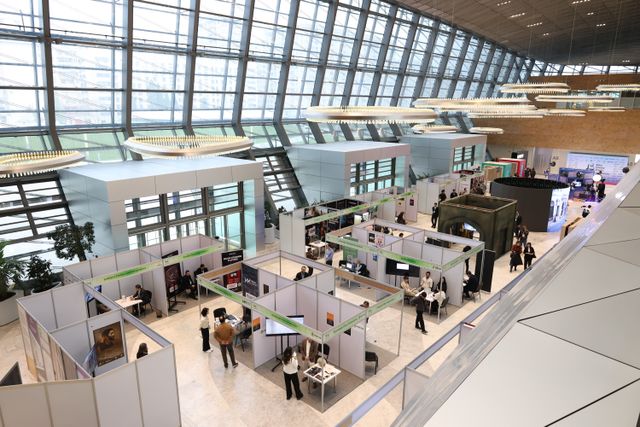
CHICAGO, September 8, 2026 – As you walk into the massive halls of McCormick Place, the din of industry assaults your ears before you even process the scale of the space. Squealing pneumatics, the shrill whirring of five-axis CNC machines, and the steady clatter of robot arms fill the air across 1.2 million square feet. It’s 9:17 AM on opening day of IMTS 2026—and nearly 90,000 engineers, factory managers, and shop floor supervisors have descended on Chicago’s lakeside venue.
The atmosphere inside the convention center feels noticeably different this year. It used to be that artificial intelligence was merely a trendy, cloud-based technology buzzword confined to the slide decks of executives. Not anymore. Industrial artificial intelligence has finally reached the edge at the factory floor, where shop managers demand fast, local execution—not sky-high bandwidth bills and vague promises.
The priorities of plant owners are becoming clear as day. They do not want to receive an alert about a disaster happening because the machinery has seized up. Such an alert is irrelevant on a manufacturing line. The industry trend has now moved toward edge technology capable of identifying the micro-vibrations a few days before the machinery fails.
That grounded attitude defines the entire show. Through 1,800 exhibitors and within the new Industrial AI Arena at the North Building entrance, hardware providers are showing lightweight language models working directly on-device via CNC controllers and micro-edge gateways. By fusing thermal, acoustic, and tri-axial accelerometer streams locally, these units predict tool wear up to two weeks in advance while keeping sensitive operational data strictly inside plant walls.
Wednesday’s dedicated IMTS Industrial AI Conference underscores how quickly these systems are moving from passive monitoring to autonomous action. “We’re moving past simple alerts,” noted conference presenter Sarah Lin, emphasizing that modern systems must “take immediate action directly on the line.” AI-driven autonomous agents on the machine do not merely alert to bearing friction but initiate job orders, inventory checks for replacement parts, and even regulate spindle feed rates during cutting operations to prevent abrupt breakage. At the same time, computer vision technology inspects 2,000 parts per minute with remarkable accuracy and sends immediate adjustments to the control system.
Undoubtedly, the conversion process is not without its share of surprises. Unexpected problems – such as difficult-to-process data from traditional sensors, complex retrofits, and initial expenses – tend to trip up many executives.
But the pull of economics can’t be ignored either. A consistent lack of labor continues to plague medium-size job shops, making automated quality control a necessity rather than a convenience. Those who have already embraced the technology have seen their unplanned downtime decrease by 18%, along with their scrap rates by 12%.
By midafternoon, the aisles around the live demonstration areas are jammed shoulder-to-shoulder. Robots load billets of raw aluminum alloy into the milling machine in a manner that would make any machine operator proud, while edge vision sensors examine completed products in a matter of seconds.
It is clear, as the event draws to a close on September 19th, that smart manufacturing has arrived.